Summer Vibes Stories
  • Health News
  • Health Care
  • Staying Healthy
  • Beauty Advices
No Result
View All Result
  • Health News
  • Health Care
  • Staying Healthy
  • Beauty Advices
No Result
View All Result
Summer Vibes Stories
No Result
View All Result
Home Health News

A molecular ‘warhead’ against disease

by
April 24, 2024
in Health News
0
A molecular ‘warhead’ against disease

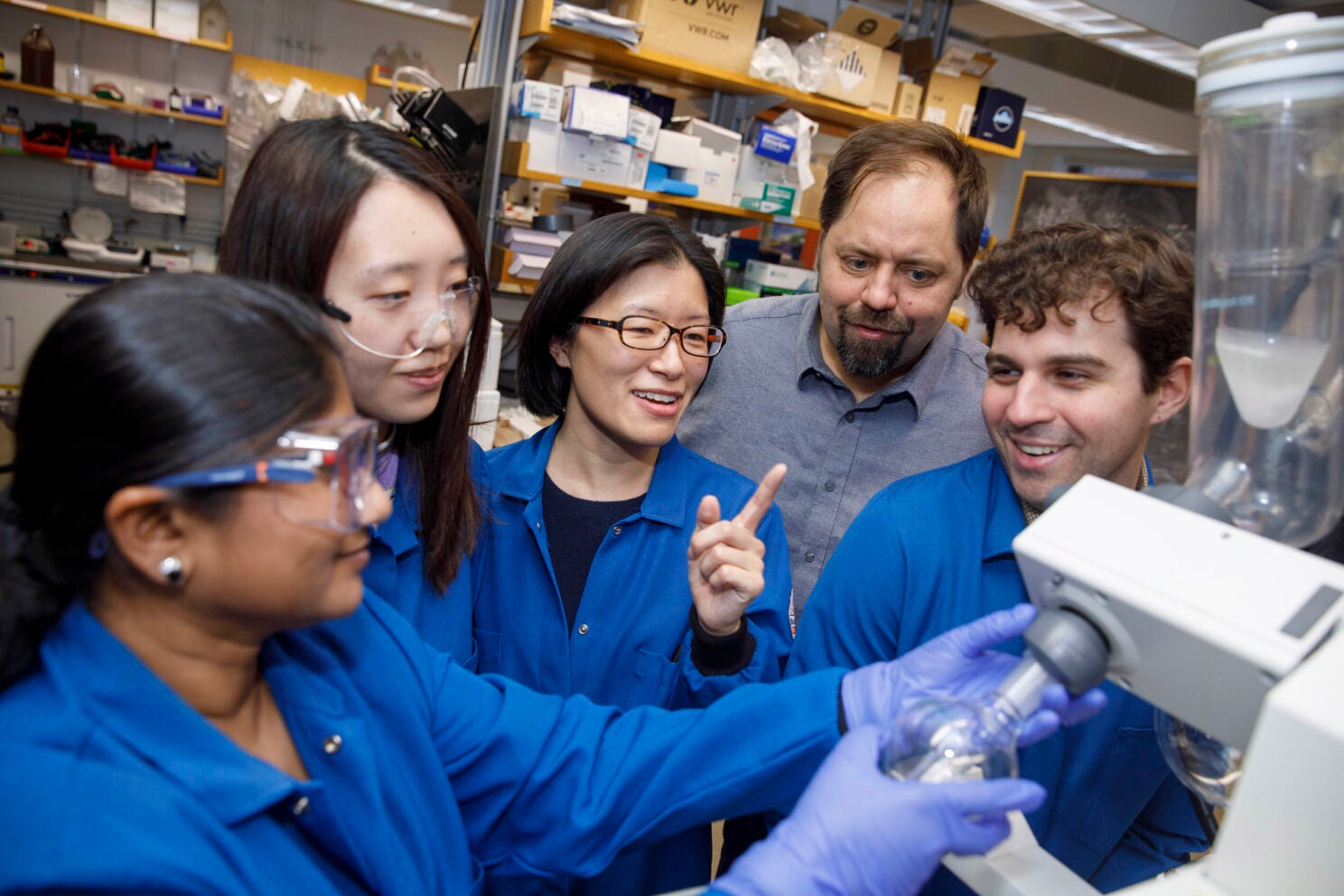
Cristina Woo (center) in her lab with study co-authors Nandini Vallavoju (from left), Wenqing Xu, Ralph Mazitschek, and Connor Payne.

Kris Snibbe/Harvard Staff Photographer


Health

A molecular ‘warhead’ against disease

Approach attacks errant proteins at their roots

Yahya Chaudry

Harvard Correspondent

April 2, 2024


3 min read

In the battle against cancer and other diseases, scientists are developing molecular weapons that can be used to stop uncontrollable cell growth.

A team of Harvard and Massachusetts General Hospital scientists have found that “cyclimids,” a class of binding molecules known as ligands, offer a promising and efficient approach to removing disease-causing or malfunctioning proteins. Their distinct properties enable scientists to attack errant proteins at their molecular roots.

“For over a year we had been tackling the question of what are the natural ligands that are recognized by cereblon, a protein crucial to targeted degradation,” said senior co-author Christina Woo, Morris Kahn Associate Professor of Chemistry and Chemical Biology. “This study comprehensively characterizes these ligands to provide new insights to cereblon biology and how to hijack it.”

In recent years, scientists have engineered small molecules to specifically target proteins associated with disease. These molecules have two roles: they latch onto the target protein that needs to be removed, and their “warhead” engages with part of the cellular cleanup system, often binding to a protein called cereblon. Together, these specialized molecules form what scientists call a ternary complex. Once this complex is established, the target protein gets effectively marked for disposal by the cell’s proteasome, which acts like a cellular recycling system. The success of this process — removing specific proteins — is dependent on the design and efficiency of the molecular warhead, making them crucial elements in the development of therapies for various diseases, including cancer.

In the researchers’ paper published in Cell: Chemical Biology, they found that minor structural changes on the cereblon ligand can dramatically alter biological activities in cells. In collaboration with the Mazitschek Lab, which has done extensive research into the identification of disease-relevant molecular targets, the researchers introduced a systematic biochemical approach for quantifying ternary complex formation. This method allows researchers to predict the cellular degradation activity of cyclimids more effectively, streamlining the development process.

“We have given the community a powerful and affordable microscope with our method,” Ralph Mazitschek, co-senior author, said. “We have established a comprehensive, reliable, robust, and sensitive profiling platform that is applicable to virtually any of these small molecule degraders and molecular glue degraders.”

“This was a collaboration in the truest sense of the word,”  said Connor Payne, postdoctoral fellow in Mazitschek’s lab. “We had different expertises, and different technologies that we were developing so the synergy between them was really, really beautiful to see come to fruition.”

Going forward, Woo and Mazitschek are optimistic that cyclimids and their screening platforms will be incorporated into protein-degradation strategies, which could be useful in developing drugs and treating cancers.

“I think our research will ultimately facilitate profiling many more molecules against desired targets and arrive at more selective and efficacious molecules faster,” Woo said. “There are a lot of different directions this could take us.”

The following graduate students in Woo’s lab also took part in the research: Saki Ichikawa, Wenqing Xu, Chia-Fu Chang, Nandini Vallavoju, Hope A. Flaxman, and Spencer Frome.

Previous Post

Asking the internet about birth control

Next Post

When will patients see personalized cancer vaccines?

Next Post
When will patients see personalized cancer vaccines?

When will patients see personalized cancer vaccines?

  • Trending
  • Comments
  • Latest
Interval training: A shorter, more enjoyable workout?

Building simple habits for healthy weight loss

May 21, 2024
F-1 Doctors help international students to U.S. med schools

F-1 Doctors help international students to U.S. med schools

June 4, 2022
Interval training: A shorter, more enjoyable workout?

10 behaviors for healthy weight loss

May 21, 2024
A connection between ancestry and the molecular makeup of cancer

A connection between ancestry and the molecular makeup of cancer

June 4, 2022
Novel teamwork, promising results for glioblastoma treatment

Novel teamwork, promising results for glioblastoma treatment

0
‘Harvard Thinking’: Facing death with dignity

‘Harvard Thinking’: Facing death with dignity

0
Interval training: A shorter, more enjoyable workout?

10 behaviors for healthy weight loss

0
Asking the internet about birth control

Asking the internet about birth control

0
What’s next for GLP-1s?

What’s next for GLP-1s?

February 27, 2026
Drinking 2-3 cups of coffee a day tied to lower dementia risk

Drinking 2-3 cups of coffee a day tied to lower dementia risk

February 26, 2026
New AI tool predicts brain age, dementia risk, cancer survival

New AI tool predicts brain age, dementia risk, cancer survival

February 24, 2026
It’s time to get more comfortable with talking about dying

It’s time to get more comfortable with talking about dying

February 23, 2026

Enter Your Information Below To Receive Latest News And Articles

    Your information is secure and your privacy is protected. By opting in you agree to receive emails from us. Remember that you can opt-out any time, we hate spam too!

    Recent News

    What’s next for GLP-1s?

    What’s next for GLP-1s?

    February 27, 2026
    Drinking 2-3 cups of coffee a day tied to lower dementia risk

    Drinking 2-3 cups of coffee a day tied to lower dementia risk

    February 26, 2026
    New AI tool predicts brain age, dementia risk, cancer survival

    New AI tool predicts brain age, dementia risk, cancer survival

    February 24, 2026
    It’s time to get more comfortable with talking about dying

    It’s time to get more comfortable with talking about dying

    February 23, 2026

    Recent News

    What’s next for GLP-1s?

    What’s next for GLP-1s?

    February 27, 2026
    Drinking 2-3 cups of coffee a day tied to lower dementia risk

    Drinking 2-3 cups of coffee a day tied to lower dementia risk

    February 26, 2026

    Popular News

    • What’s next for GLP-1s?
    • Drinking 2-3 cups of coffee a day tied to lower dementia risk

    About Summer Vibes Stories

    • Contact us
    • Privacy Policy
    • Terms & Conditions
    • Email Whitelisting
    • Contact us
    • Privacy Policy
    • Terms & Conditions
    • Email Whitelisting

    Copyright © 2024 Summervibesstories.com. All Rights Reserved.

    No Result
    View All Result
    • Health News
    • Health Care
    • Staying Healthy
    • Beauty Advices

    Copyright © 2024 Summervibesstories.com. All Rights Reserved.