
Health
Why we need Black bioethics
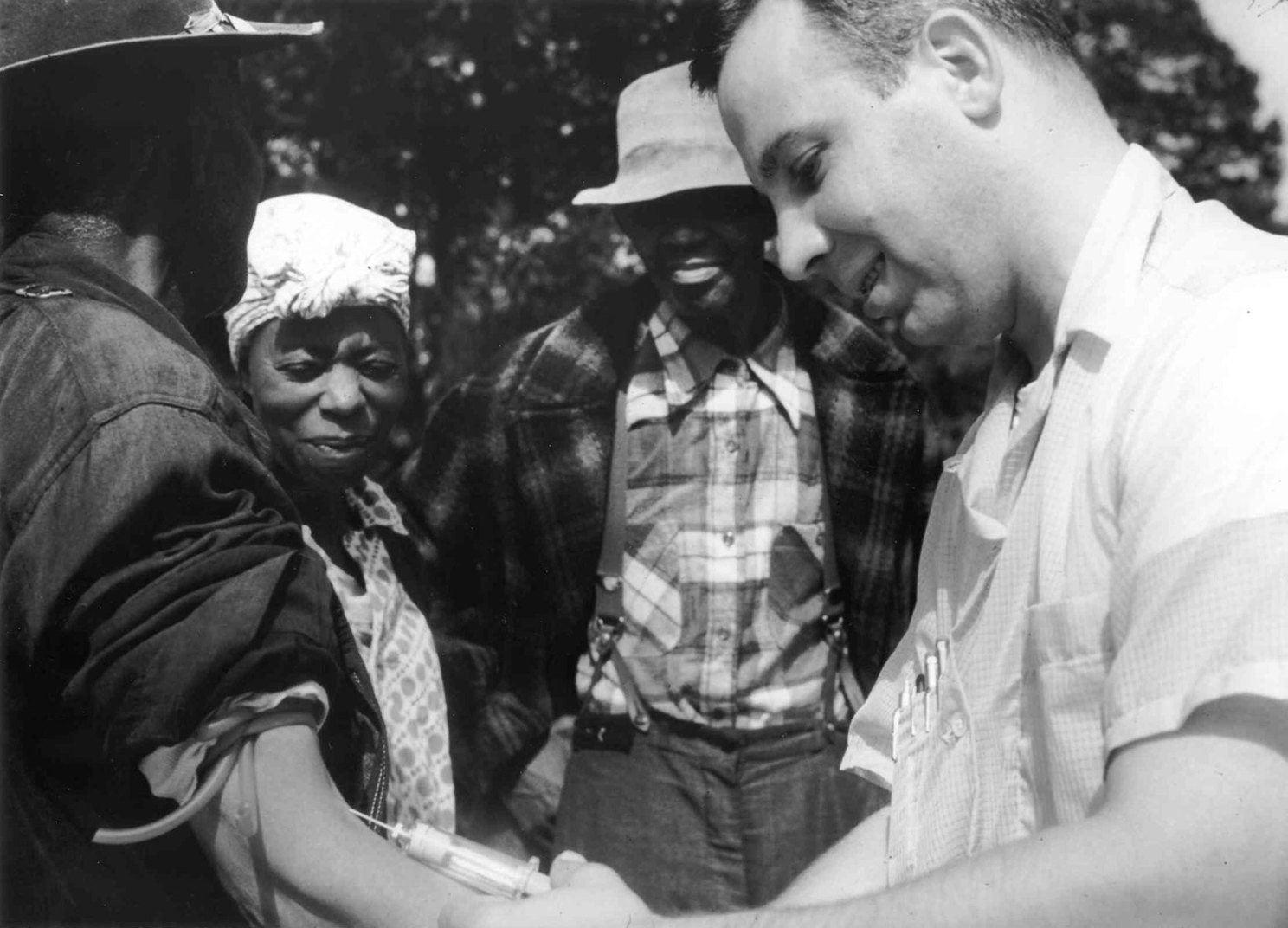
A doctor drawing blood from a patient as part of the Tuskegee Syphilis Study.
Public Domain/National Archives
Panel points to historical examples, including Tuskegee experiment, pandemic, and life expectancy inequities
There is a need for a Black bioethics, argued a recent panel sponsored by Harvard Medical School and Tuskegee University. One need look no farther than inequities in COVID-19 diagnoses and treatment during the pandemic for evidence, but another, devastating historical example is the 40-year-long Tuskegee experiment.
Moderator Rebecca Brendel, director of the HMS Center for Bioethics, gave a quick recap of the experiment, in which several hundred Black sharecroppers were enrolled in a U.S. Public Health Service study.
The 399 participants, all suffering from syphilis, were told they had “bad blood” so researchers could observe the progress of the untreated deadly disease in human subjects. The study ran from 1932 to 1972.
In 1978, a national committee of physicians, lawyers, and scientists issued The Belmont Report, which outlined ethical guidelines. (An official apology, from President Bill Clinton, finally came in 1997.)
Adie Fein/Harvard Chan School
But nearly 40 years after The Belmont Report, discrimination in healthcare remains a stark reality. Black mortality rates are still significantly higher than those of white people in the U.S., said panelist David Augustin Hodge, interim director, lead ethicist, and research professor at the National Center for Bioethics in Research and Healthcare at Tuskegee.
“Black people die at a faster rate. Life expectancy is lower,” said Hodge. Minority children “are 3.5 times more likely to die in childhood” than white. These discrepancies translate to “about 80 million years of life that have been lost between 1999 and 2020,” he said.
Such deaths are often attributed to causes unrelated to race. For example, the higher mortality rate of Black people with COVID is blamed on co-morbidities. But the co-morbidities that make Black people more vulnerable, such as diabetes, are themselves a result of a healthcare system that has failed the Black community.
“If we do not give attention to Black lives and brown lives and the lives of the vulnerable, we will see these things happen,” said panelist T.S. Harvey, associate professor of medical and linguistic anthropology and global health at Vanderbilt University.
The Belmont Report, as Harvey pointed out is “strictly limited,” in that it discusses only research with human subjects.
Considering these strictures, “it has been applied too broadly” as an answer to discrimination, he said. Instead, bioethicists need to look to liberation theology as a model of “inclusiveness rather than exclusiveness,” he said.
“As a Black bioethicist. I’m just as interested in our Native American population. I’m just as interested in Alaskan or Asian Pacific populations. I’m just as interested in my Hispanic brothers down on the border, the Mexican brothers and sisters, or the Cuban brothers and sisters. In those in the Appalachian Mountains, those who are poor,” Harvey said.
“Because quite frankly, when we’re talking about ethics and when we’re talking about principles, we are talking about the least of us,” as liberation theology teaches, he said.
“If we do not understand or start to work with the power of implicit bias in technology, we will continue to go down the road of excising those communities that need to be involved.”
David Augustin Hodge
Complicating the problem of healthcare discrepancies is the rising use of AI in both medical and sociological research, both noted. Because AI draws from published material, it is inherently backward-looking — and replicates the biased research of the past, such as studies that only included white people or only men.
“Technology for all of its capabilities, whether or not we’re talking about artificial intelligence, large language models, or really sophisticated prosthetics, is not neutral,” said Harvey. “It replicates existing structures, existing notions.”
“If we do not understand or start to work with the power of implicit bias in technology, we will continue to go down the road of excising those communities that need to be involved,” said Hodge.
Exclusion also occurs “not by racism, but by comfort zones,” Hodge continued, noting that researchers tend to think in terms of the communities to which they belong. “When we’re talking about clinical trials, we [should be] talking about making the invisible visible,” he said.
To counter this ingrained racism and classism, said Harvey, we must “think about health disparities and who are the populations that are impacted now, and then reimagine those technologies and reimagine those interventions by understanding those challenges. But to do that, we have to move beyond utilitarian ethics to what Dr. Hodge talks about as fundamentally relational.”
“We can use many, many different philosophical frames to think this through, but we need to recognize that technology is there as an aid and can be used in many, many ways, but also understand the kinds of disparities that some of these technologies reproduce,” he said.
One model may be found in the gaming community, where “the technology is in the hands of the gamers,” he said. In other words, it is driven by the users, which in healthcare would mean the patients or clients.
Beyond that, “I continue to push,” said Hodge, even as he identified a source of hope: “Young people are thinking about this kind of work: public health ethics, public health and bioethics, neuroethics, etc. It is important to engage.”
“What we hope to do is to build beyond,” concluded Harvey. “Reimagine the possibilities to think about the complexity of the problems as human problems that have human solutions.”
“Bioethics and Black History: The Legacy of the Tuskegee Report” was organized by the Harvard Medical School Center for Bioethics, the National Center for Bioethics in Research and Health Care at Tuskegee University, and the HMS Office for Culture and Community Engagement as part of the series “Reflecting on the History of Healthcare,” available on the HMS Center for Bioethics YouTube community