
Health
Predicting cancer outcomes with a selfie
Slower ‘face aging’ linked to better survival odds, according to second study of AI tool designed to aid precision care
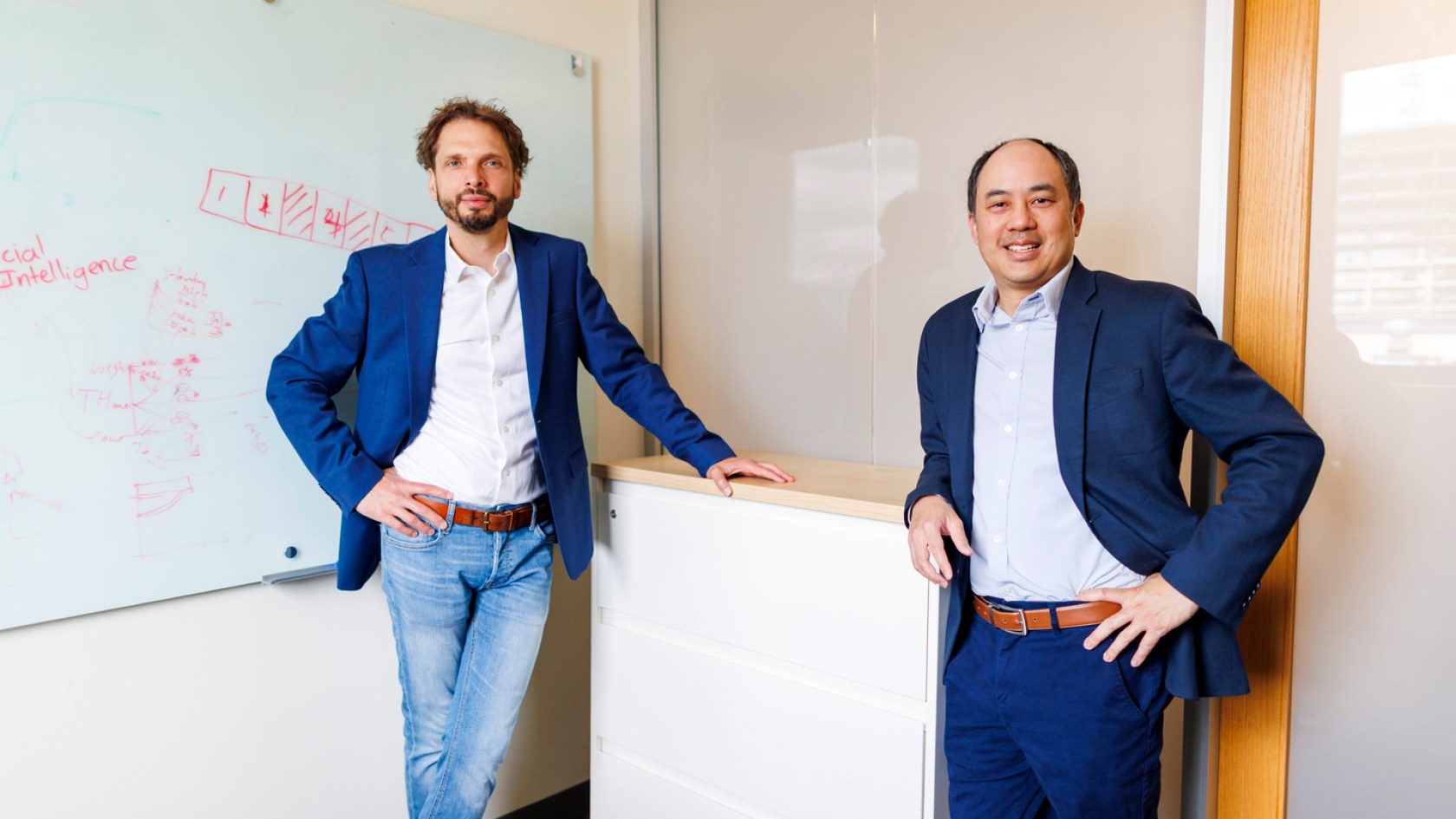
Hugo Aerts (left) and Raymond Mak.
Stephanie Mitchell/Harvard Staff Photographer
Researchers using artificial intelligence to plumb links between biological age and cancer outcomes have linked both looking younger than your chronological age and appearing to age slower during treatment to improved survival.
The work, which follows a pilot study published in May 2025, highlights how medical artificial intelligence and simple digital photographs of patients’ faces can be harnessed in a tool with the potential to improve screening and treatment outcomes.
Highlighted in two separate studies, the work explored the potential utility of the idea that one’s biological age can vary from one’s chronological age and that difference can be clinically meaningful. If confirmed by ongoing clinical studies, the tool could one day provide screening by simply uploading a digital photograph for analysis by an algorithm developed by researchers, dubbed FaceAge.
The tool could also guide physicians to counsel patients differently depending on their biological age. If, for example, a patient is relatively youthful biologically, a physician might suggest more aggressive treatment, while steering to a less rigorous course for someone of the same chronological age but biologically older and frailer.
Raymond Mak, an associate professor of radiation oncology at Harvard Medical School and Mass General Brigham Cancer Institute and co-senior author of the two studies, said that a person’s chronological age is already a fundamental metric physicians note when making diagnostic and treatment decisions.
“One of the first numbers they put in is your chronological age. It’s done by every single primary care doctor, the same with a pre-op evaluation, the same with a lot of our risk calculators and cancer care,” Mak said. “What we’re arguing is why use chronological age when we’re seeing these massive deflections between biological age and chronological age? Why not use something that might be more precise for an individual?”
“What we’re arguing is why use chronological age when we’re seeing these massive deflections between biological age and chronological age? ”
Raymond Mak
Specifically, the two studies examined the association between three new metrics — FaceAge, FaceAge Deviation, and Face Aging Rate — and outcomes for thousands of cancer patients.
The first study, published in November in the Journal of the National Cancer Institute, showed that a cancer patients’ face age — the age that they appear to be — is older than their chronological age for 65 percent of more than 24,000 cancer patients. Further, it highlighted a strong association between cancer outcomes and the size of the gap between face age and chronological age. Those who looked five years or more younger than their chronological age had significantly better outcomes, and those who looked 10 years or more older than their chronological age had significantly worse outcomes.
“Every cancer is different, but the thing that was surprising was how clear the signal was across multiple cancer types,” Mak said.
In the second paper, published in the journal Nature Communications in April, researchers looked at the changes in face age between two points in time and calculated a face aging rate. They found that a slower face aging rate is associated with better cancer survival while a faster rate is associated with worse survival.
The work was done on a cohort of 2,276 cancer patients over 20 years old who were undergoing at least two courses of radiation therapy. Photographs were taken as a routine part of the therapy visit and, when analyzed by the FaceAge algorithm, highlighted the toll the advancing cancer and the rigorous therapy took on patients between the two visits. The median value for patients’ initial face age was 0.99 years older than their chronological age, a gap that roughly doubled, to a median of 1.85 years older, by the time of the second photograph.
Researchers then divided the cohort into three groups whose time interval between treatment varied: less than a year, a year to two years, and two to four years. Time between treatment is an indication of disease severity, researchers said, since those with more advanced cancer would get radiation therapy on an accelerated schedule.
Researchers found that those in the shortest interval group with the fastest face-aging rate did the most poorly, surviving a median of 4.1 months versus 6.5 months for those with decelerating face aging. Similarly, those in the intermediate group with the fastest face aging rate survived a median of 6.4 months compared with 12.5 months for those with decelerating face aging. The same pattern held in those with the longest interval and least severe disease: Those with the fastest face aging rate survived 15.2 months compared with 36.5 months for those with decelerated aging.
The second study debuted the next generation of the FaceAge algorithm, researchers said. The “deep learning” algorithm teaches itself and was trained on massive amounts of data layered in a way that creates a powerful and flexible tool, according to Hugo Aerts, professor of radiation oncology at Harvard Medical School and Mass General Brigham AI in Medicine, also a co-senior author of the two papers.
Aerts said that though the original algorithm was trained on 58,000 photographs of people of known age and 6,000 images of cancer patients of known age and clinical outcome, it was only able to provide a clear signal for those with relatively large variations from their chronological age, with a “noisier” signal for those with smaller deviations.
Since machine-learning algorithms improve when trained on more data that captures greater variation, the FaceAge 2.0 algorithm used in the second study was trained in layers. First, it was given a data set of 40 million images of faces from around the world on which it learned to recognize human faces and identify facial features. Researchers then gave it 700,000 images of faces of known age, on which it trained itself to recognize faces and facial features from around the world of a particular age.
Lastly, in what Aerts described as the final layer of a pyramid, they provided images of 24,000 cancer patients whose outcome was known, a volume that, on its own, would be too small for an algorithm to be accurate. The combined result, Aerts said, is a tunable platform that can be retrained by changing the data in that small, tip-of-the-pyramid group and that could be refocused on specific cancers or other diseases.
“The nice thing is that is if you use that 40 million to train a foundation model, then you need way fewer individuals to get to high performance at 700,000. And once you have that model, you can fine-tune it further to a very specific task, using very small training data sets,” Aerts said. “Those first two layers, the 40 million and the 700,000, are a potential resource. If you decide to go in a different direction, you don’t have to reinvent the wheel. You go back to your original data set that is really good at telling age and say, ‘Now do this other thing.’”
While the algorithm has already illustrated an association between different measures of face age and disease outcome, Aerts and Mak said they are working to improve its performance with different skin types, when subjects are wearing makeup, or have undergone plastic surgery. They also acknowledge that, while their work has shown a general association between face age and biological age, aging might affect different organs differently, and there may be value to creating measures of “heart age” or “liver age,” for example, that vary from face age and even from the age of other organs in the body.
Researchers from different specialties have expressed interest in collaborating with the FaceAge team and individuals around the world have expressed an interest in the work, Mak and Aerts said. In response, they’ve begun a clinical study using an online portal where members of the public can upload images of themselves and get a FaceAge assessment.
If trial results continue to be positive, Aerts said, FaceAge has the potential to be a simple, inexpensive way to monitor one’s health, but one that would add to physicians’ tool kits instead of replacing established imaging methods like CT scans or MRIs.
“CT and MRI will generate much, much more information. But you cannot take an MRI every day of every individual in the world,” Aerts said. “The beauty of this is you can get rougher, but more frequent health assessments using a very simple picture.”