
Photos by Niles Singer/Harvard Staff Photographer
Health
Weighing cure for sick kids against troubling ethical questions
Science Center talk outlines potential and risks of gene editing
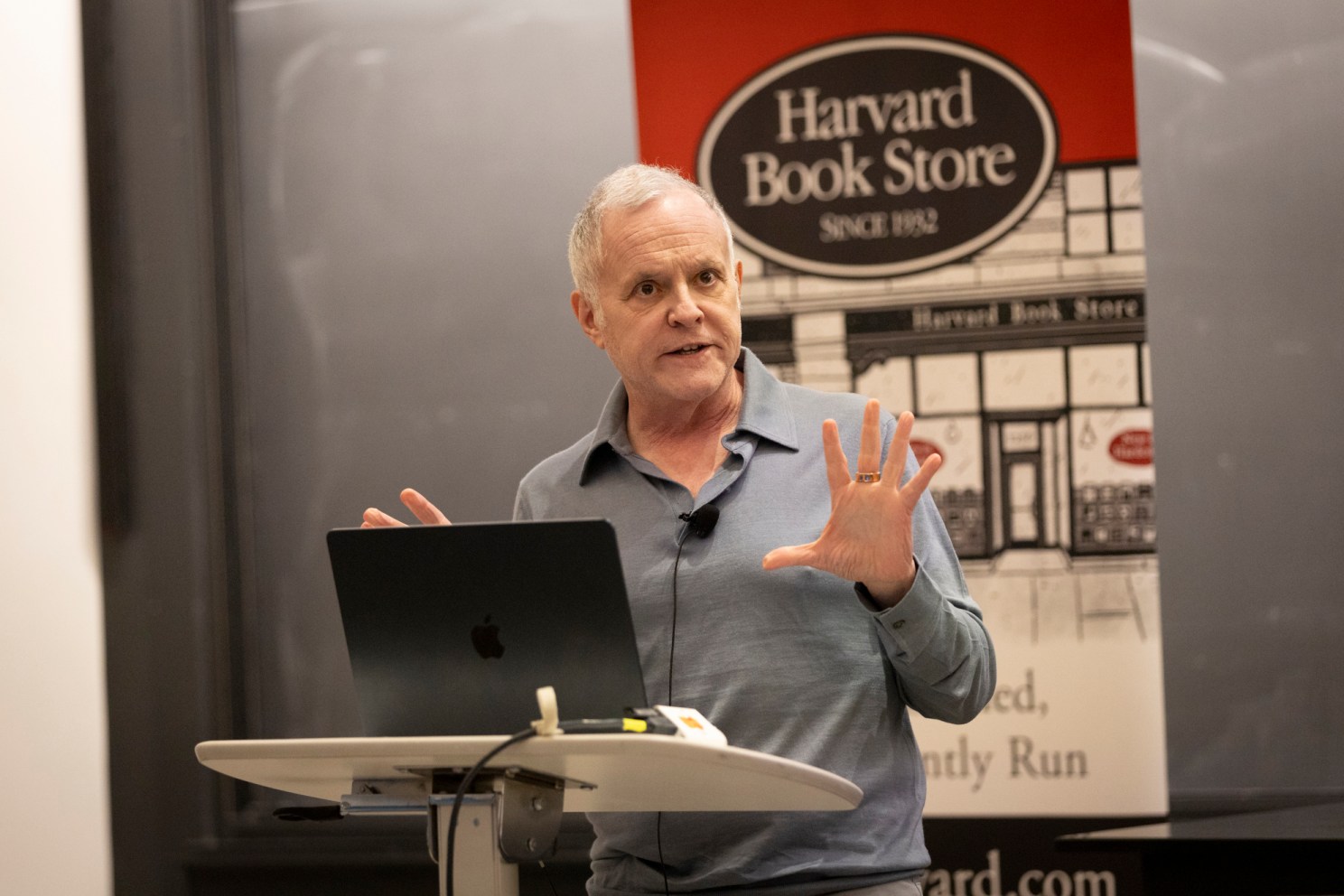
If our differences are part of what make us human, do we have the right — or the responsibility — to change them? That question was at the crux of “The Promise and Peril of CRISPR,” a talk given by Neal Baer, Ed.M. ’79, M.D. ’96, co-director of Harvard Medical School’s master’s degree program in Media, Medicine, and Health. At the Science Center presentation co-sponsored by the FAS’ Division of Science and Harvard Library, Baer discussed the ethical issues surrounding the gene-editing technology with Rebecca Weintraub Brendel, director of the Medical School’s Center for Bioethics.
Introducing the subject — and the book he has edited with the same title — Baer recalled his “horrible” early experience treating children with sickle cell anemia at Children’s Hospital in Los Angeles. “They were suffering. They had strokes,” he recalled. “And there was very little we could do.
“Now,” thanks to CRISPR, “we can cure sickle cell,” he said.
But should we? That remains the central issue for Baer, who also works as a screenwriter, dramatizing medical issues for TV shows such as “Designated Survivor” and “Law and Order: SVU.” (“I am Olivia Benson,” he told the audience, referring to the “Law and Order” protagonist).
With CRISPR technology, scientists can now edit both somatic genes (from the body) and germline genes (from gametes, the sex cells that form embryos), literally clipping out and replacing parts of them. In the case of sickle cell, manipulation of somatic cells can and has removed the genes underlying the disease in individuals. If such changes were made in germline cells, the resulting embryo would never develop the disease at all.
But while curing this painful disease may seem like an unalloyed positive, the questions around gene editing raise many troubling ethical questions. “Should we be using CRISPR for diseases or syndromes that are compatible with life, like Down syndrome?” asked Baer. “Who is going to make those decisions?”
The cost of gene manipulation is another factor. The sickle cell “cure,” for example, comes at a cost of roughly $2.2 million. Noting that approximately 100,000 people in the U.S. suffer from sickle cell, he asked, “Who is going to pay for it?” The domestic population, he continued, is only a fraction of the global sufferers, which raises issues of fairness and health equity.
Neal Baer (left) and Rebecca Brendel speaking during the event.
Citing this “cautionary tale,” Brendel became pragmatic. “The reality is that when we have innovation it makes those who have, have more, and those who don’t have, have less,” she said. “We can’t just innovate without thinking of the ethics. We have to think about the health justice implications as well.”
Even if curing sickle cell is considered a good, Baer argued, the changes made possible by this technology are troubling. For example, what if two deaf parents want their child genetically modified to be able to hear? “Should parents make that decision for their child? Is it up to parents to decide what attributes their children should have?”
In one of the book’s chapters, contributor Ethan J. Weiss divulged that had he and his wife known of their daughter’s albinism, “We would have aborted. But now that we have her, we can’t think of the world without her.”
Baer went on to quote Carol Padden, dean of social sciences at the University of California, San Diego, who was born deaf. “I don’t have a pathology,” she has said. “I have something called human variation. I don’t need to be ‘fixed.’”
Another concern is oversight. “Yes, it is illegal to clone. Yes, it’s illegal to do germline editing. But who is monitoring in Russia?” Baer asked. “Or China?” As if taking a page from a TV drama script, he discussed the possibilities of soldiers genetically altered to feel less pain, fear, or fatigue.
Additionally, Baer pointed out, gene editing may have unintended consequences. He cited a recent advance by the doctor and pharmaceutical company executive Sekar Kathiresan that allowed him to edit the gene controlling LDL cholesterol. While permanently lowering “bad” cholesterol, which is implicated in heart disease and strokes, sounds like a “win,” said Baer, the science isn’t that simple. “This gene evolved over 3 billion years and is involved in dozens and dozens of other” reactions, he said, including those involving insulin and other factors.
“Genes don’t just pop out,” he said. “They evolve and interact and do many different things.”