
Health
A clearer picture of drinking and disease
New study attempts to reconcile conflicting findings on benefits vs. risks
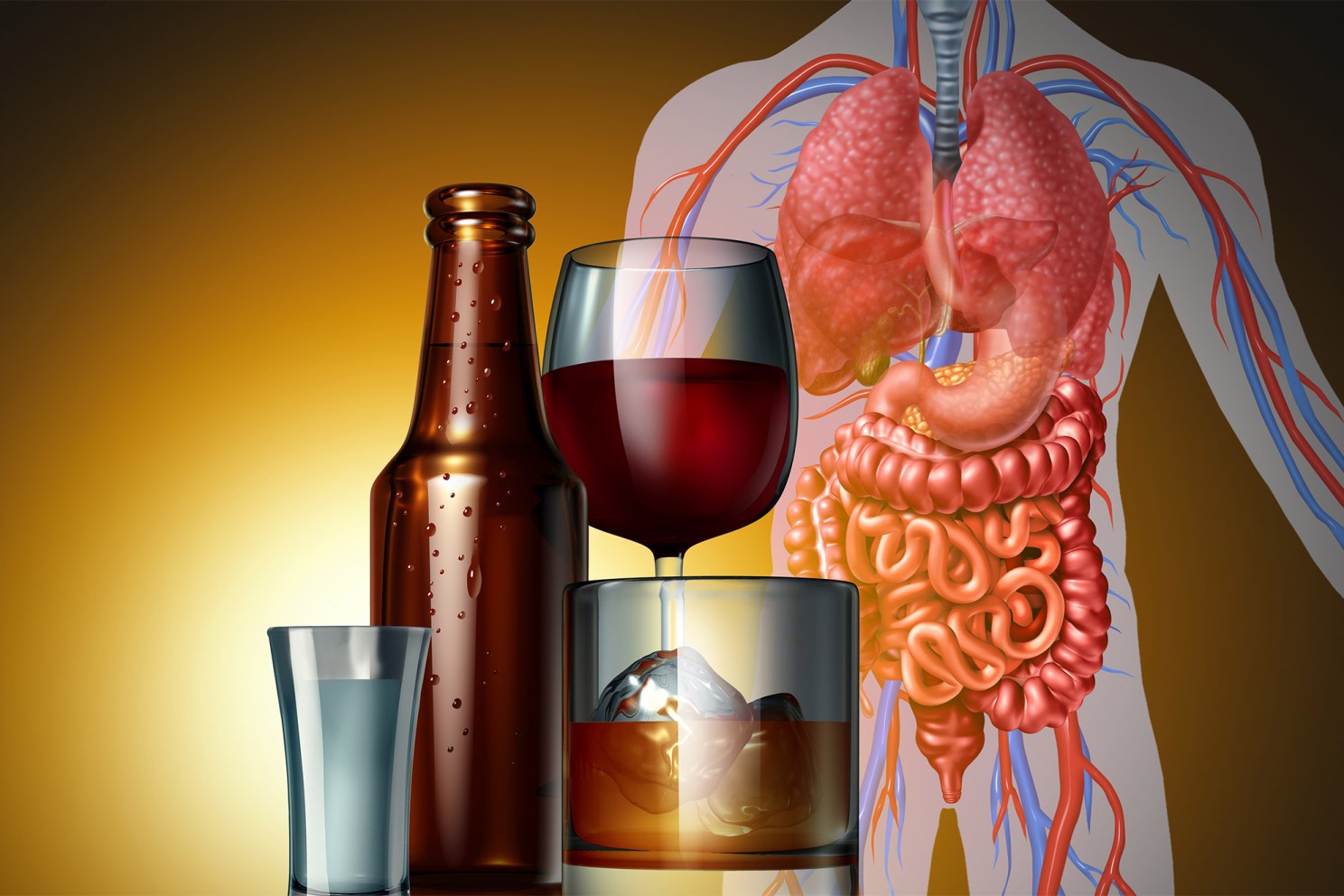
Studies of alcohol’s effects on health have offered contradictory findings, with some suggesting a glass of red wine a day is beneficial and others saying even a drop of booze is too much. A new review attempting to clarify the risks finds more than 60 diseases, based on the World Health Organization’s International Classification of Diseases, are 100 percent attributable to consuming alcohol. But the review also finds that some of the damage can be slowed or reversed by cutting down or quitting drinking.
Sinclair Carr, a doctoral candidate in the Department of Epidemiology at the Harvard T.H. Chan School of Public Health and the first author on the study, worked with a team to review a range of studies on alcohol and challenge their potential assumptions and biases. In an interview edited for clarity and length, Carr and senior author Jürgen Rehm of the Institute for Mental Health Policy Research at the Centre for Addiction and Mental Health, discussed their findings.
What was the purpose of this study?
Rehm: This study is an update to a series of reviews that inform global assessments — such as the Global Burden of Disease Study and the WHO’s Global Status Report on Alcohol and Health — which aim to quantify how much risk factors like alcohol and tobacco contribute to the global burden of disease and injury. It became clear that there wasn’t enough evidence about the various risks of alcohol, so we began to look at two different dimensions of alcohol that are relevant for health: the average level of drinking (i.e., how many drinks per day, week, etc.) and the patterns of drinking (i.e., the different occasions during which one consumes alcohol). We’ve been doing updates of this review roughly every seven years, but the hope was that this update would reconcile some of the classic epidemiological practices with the newer approach of Mendelian randomization.
“The problem with many chronic diseases is that some of the damage, like in the liver, is not reversible. However, reducing or stopping drinking can slow the disease’s progression.”
Sinclair Carr
Carr: This new wave of Mendelian randomization studies (which use information on people’s genes) has been important to the field. They have really changed the perspective on some of the potential health risks of alcohol, particularly for heart diseases and ischemic stroke. Many Mendelian randomization studies found no association between alcohol consumption and risk of these diseases, but conventional observational studies did show an association, one that suggests a little consumption might lower your risk. This is where that idea of “a glass of red wine a day is beneficial for your heart” came from. More recently, people have questioned whether this potential protective effect is actually true given the contradictory findings across study designs. We hoped this new review would provide clarity.
Could you give an example of a bias?
Carr: An association between alcohol and health that suggests a benefit of drinking in moderation might be explained by something other than alcohol consumption itself. Perhaps it wasn’t the alcohol causing the improvements in health, but rather other factors, like being a bit wealthier, having a better diet, etc. For example, take ischemic heart disease, the condition where the different study designs disagree most. We reviewed the Mendelian randomization studies on it and learned that many were not as free from bias as is often claimed.
What were your main takeaways from the review?
Rehm: There is no safe level for alcohol consumption with regard to cancer, period. Any amount of alcohol consumption increases your risk for several types of cancer. But on the other hand, the risk isn’t necessarily there for other diseases. Take breast cancer, which is the most studied cancer. Having one glass of wine every other day increases the risk of breast cancer but is also potentially protective for heart disease. We cannot say that there is risk-free drinking, but we also cannot say that low amounts are clearly harmful. Basically, the increased risk of one disease could be canceled out by the reduced risk of another.
“There is no safe level for alcohol consumption with regard to cancer, period. Any amount of alcohol consumption increases your risk for several types of cancer.”
Jürgen Rehm
What we are doing as epidemiologists is creating a conceptual picture for a population. You, as an individual, have way more information. If you know your grandfather, father, grandmother, and mother all died of heart disease, what’s best for you may be different from someone else whose family members died of cancer.
Did the type of alcohol matter? So, for example, a glass of red wine versus a shot of whiskey.
Rehm: No. Alcohol is alcohol is alcohol. There is no scientific evidence that type matters.
What did you find in terms of slowing or reversing the effects of alcohol and health?
Carr: You can slow down or reverse the damage, depending on the type of disease or injury, although most of the evidence we have comes from people who were drinking heavily. The most obvious examples are some of the acute risks of drinking, like drunken driving accidents, which disappear once you stop. There is also evidence that you can reverse some physical damage. For example, we know from randomized trials that when you cut down your consumption, you can lower your blood pressure, which is a major risk factor for heart disease. For brain damage, you may reverse some of the shrinkage of the brain when you stop drinking. Cancer risk may also decrease after stopping drinking. The problem with many chronic diseases is that some of the damage, like in the liver, is not reversible. However, reducing or stopping drinking can slow the disease’s progression.
What did this review reveal about what we still need to learn?
Carr: There is a lot of room for improvement in research on alcohol and health. Ideally, we would have randomized trials, which are considered the gold standard to assess causal effects; it’s clearly unethical to make people drink, but trials could ask people to stop or reduce their alcohol consumption and study the effects. If a trial is not feasible, it is helpful to specify the trial we would like to run and use observational data to emulate it. This forces us to define the question precisely and helps avoid major biases that have plagued the literature.
How do you hope these findings will empower individuals to have agency over their own health?
Carr: We hope the main effect is better information. People make their own decisions about drinking, and they should, but those decisions should be informed by a clear understanding of the potential health effects of drinking. For example, many do not know that alcohol increases the risk of several cancers. Since some harms appear to partly reverse when people cut down or stop, reducing can be worthwhile even after years of heavy drinking.
The aim is not to tell people what to do, but to give them an accurate picture of how drinking may affect their health, so they can decide for themselves. That said, this picture is still far from complete. Many important questions remain unanswered, and we clearly need better-designed studies, along with appropriate methods, to attempt to answer them.